



A five-year effort aimed at the people current AI models leave behind
The Gates Foundation on Monday, September 21, 2026, brought together 60 organizations from the technology, research, government and philanthropic sectors behind a five-year effort to make artificial intelligence more useful in languages that remain poorly represented in today’s models.
The coalition’s goal is ambitious: help an estimated 3.4 billion people use AI services in their own language and voice. Signatories include Anthropic, Google, Microsoft, Amazon, Mistral, NVIDIA, the OpenAI Foundation, UNICEF, the World Bank Group and organizations working directly with communities in Africa, Asia and other underserved regions.
You may also like
The initiative reflects a shift in the AI race. While companies continue to compete over model releases, benchmark scores and computing capacity, the new coalition is targeting a less visible constraint: the shortage of high-quality language data, speech recordings and evaluation tools for most of the world’s roughly 7,000 languages.
For businesses and public institutions, the development could become strategically important. AI systems that perform well in English but struggle with local dialects, idioms or accents cannot reliably support health workers, teachers, farmers, banks or government agencies serving multilingual populations.
A global effort to close AI’s language gap

The coalition is designed to connect frontier AI companies with organizations that collect local data, build public-interest applications and understand the cultural context behind the languages being represented.
From translation to voice, context and local control
The Gates Foundation said the effort will focus on four areas: building shared language infrastructure, creating more honest benchmarks, turning data into usable models and applications, and ensuring that communities are protected through privacy, consent and data-sovereignty safeguards.
That agenda goes beyond translating an existing English-language product. A system may produce grammatically correct text while still misunderstanding local slang, cultural references or the way a particular community describes a medical condition, crop disease or financial problem. Speech creates another layer of difficulty because accents and dialects can vary sharply within the same language.
Google is already working on that problem through Project Vaani, an effort to collect more than 150,000 hours of audio across India’s districts. Google senior vice president James Manyika said the project relies on local partners to record speech in the field, an approach intended to capture regional differences that would be missed by a narrow set of standardized recordings.
Anthropic executive Elizabeth Kelly acknowledged that the company’s products lag in many African languages. The company has separately worked with the Gates Foundation on applications involving vaccines and local agricultural data, but the new commitment places language access at the center of a broader, multi-organization effort.
Local speech data is central to the plan
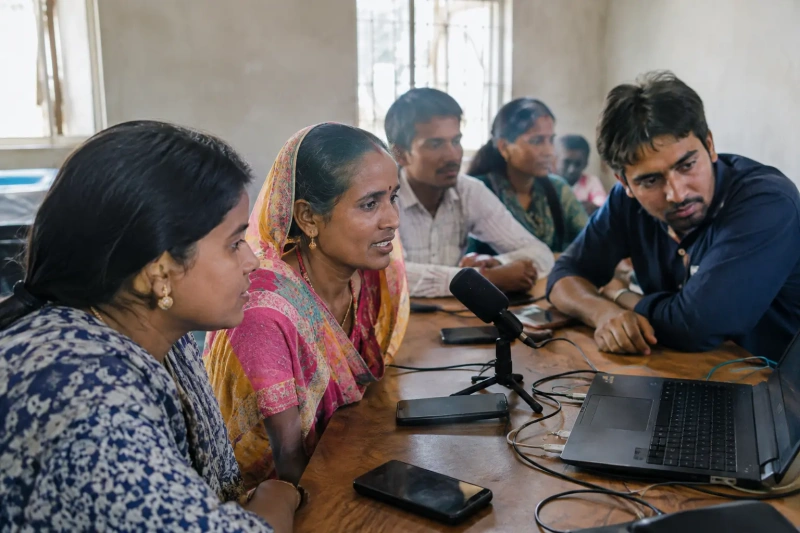
Participants say voice interfaces could be especially important where typing is less practical or where literacy and connectivity barriers limit access to text-based services.
Why the initiative matters for the next phase of AI deployment
The foundation has warned that the benefits of AI could deepen inequality if the most capable tools are built first for users and institutions able to pay for them. In a report released last week, it said more than 90% of the data used to train early large language models came from English-language sources.
That imbalance has practical consequences. A health chatbot that fails to understand a patient’s language can provide little value. An agricultural assistant that cannot recognize local terminology may give advice that farmers cannot use. A public-service system that works only in a national capital’s dominant language can exclude the people it was meant to reach.
The coalition’s structure is still being developed. The participating organizations said they will work collaboratively over the next year on governance, workstreams and benchmarks. The announcement does not yet specify a single pooled budget, a binding release schedule or a common technical standard.
That uncertainty is significant. Open language data can accelerate research, but collecting speech and text also raises difficult questions about consent, compensation, privacy and ownership. Local communities may object if their voices are gathered for commercial systems without meaningful control over how the data is used.
A test of whether AI access can be built as public infrastructure
The coalition gives major AI companies a chance to contribute resources to a problem that commercial incentives alone may not solve. Languages with smaller online populations often lack the data needed to justify expensive model development, even when millions of people speak them.
It also gives governments, universities and community organizations a larger role in determining what successful AI deployment looks like. The emphasis on benchmarks could make it easier to measure progress by real-world usefulness rather than by performance on English-language tests alone.
For the companies involved, the commitment may eventually expand the addressable market for AI services. For users, however, the meaningful measure will be more immediate: whether a farmer, nurse, student or public employee can ask for help in a familiar language and receive an answer that is accurate, culturally intelligible and safe.
The Gates-led effort does not settle the technical or political challenges. But by putting language data, voice access and local participation alongside model capability, it identifies a central question for the next phase of the industry: who gets to benefit when AI becomes infrastructure?
Source: Gates Foundation — www.gatesfoundation.org/ideas/media-center/press-releases/20...; Associated Press — apnews.com/article/aefb021bede3b02c83890f65cd540fd0

You may also like













Comments
0 comment